Bragging Rights

What gives someone the right to brag about a product they purchased? Is it the great deal because they didn't pay a lot? Is it the affluency gained since they paid its weight in gold? What about the attributes or activities the product enables? Then, what gives the brands the right to brag and puff up their chest in front of shoppers? How does all this tie into the buying process? How does all this tie into brand loyalty, but especially brand advocacy?

For any product, namely large considered purchases, the item sought reflects needs for self identity or community compliance. For example, purchasing a car [for most] isn't an act of quick consumption like with a CPG, rather an act of deliberate life forecasting. In that dream they conjure of their life, the product becomes a beacon for something bigger - emotional satisfaction, ideological alignment, or just feeling smart at every instance from their purchase. Buying takes on the ultimate act of advocacy and self-identification with your brand a shopper can make, since they are investing their time (to research, and then through continual interactions), money, personal reputation, and most importantly their trust in your branded promise.

All of this sets the foundation for how we ought to communicate. TV spots, billboards, etc. make up a huge portion of the ad spend, but Awareness comprises a very small part of the consideration process. As designers of experiences we are stewards of technology, and it is up to us to engineer relevant interactions (interfaces to the brand promise) that help people reach some greater potential.

How cool would it be that if instead of a truck website that talked about features, the site inspired unrealized personal or professional affordances? (Which is actually the backward point of features - tell about the product so people can problem solve it fitting into their life - let's take out the problem solving and just make it crystal clear.) What about if the tools made learning easy? For example my mobile phone becomes an easy way to capture car info, that then links back to a great comparative website? We're using mobile marketing in such a way to give us clear insight how people consume knowledge, and we become their best resource for feeling smart. What about tactics which become a hub for connecting with other people who are experts in the areas I have tough questions? Really the list goes on.

Now this isn't a revolutionary concept, but does require us to evolve our thinking past what we are currently creating. So what does this mean? Where do we go next with this thinking? There are opportunities everywhere to impact and raise the tide of change. Often the best approach is a phased approach. Let's talk about what might be right. Where do you want to go next? [where2@gonextconsulting.com]

Appetite for Information, or Empty Conceptual Calories?

FoodFeed (pun intended?) upon first glance seems like another way to clutter up our lives with information which adds little long-term value. However in the right hands, this data could actually help improve lives.

For example, this type of interface could be really useful for newly diagnosed Diabetics who need council on their eating habits. If this were linked to some major retailer's pharmacy or other health professional, they could begin to prescribe better eating habits. Or maybe in a community of dieters, this type of record could provide social accountability. Also possibly developing a panel of trusted "expert eaters," who are followed for great eating tips that fit similar lifestyles.

As designers of experiences we are stewards of technology, and are responsible to create relevant interactions. The trick now and in the future isn't necessarily about making new interfaces, but being able to adapt experiences which build relationships between consumers and brands. If you've got ideas but not sure how to implement them, or questions where you want to go next, send us an email and let's talk. [where2@gonextconsulting.com]

Source: FoodFeed, downloadsquad

Socialite or Social Network

I recently joined twitter and have been on a new quest to tell all my friends. It seems like a while ago first hearing people talk about the amazing impact twitter will have, but I just wasn't on board till watching this great video via Logic + Emotion.


So not only is this a great use of paper-prototyping to tell a story, the story is interesting, and the application really is good. (And at the very least, it's a great way to coordinate Happy Hours or Dirty Bar Club events!)

Don't worry, I'll keep you posted.

Which Paradigm Again?

Does, "shopper-centric," mean the same as, "shopping-centric?" And does it yield the same results as being, "use-centric?"

...Theodore Levitt gamely observed that customers don’t want quarter-inch drills; they would prefer to buy quarter-inch holes. He advised companies not to focus on products but to concentrate on developing specific solutions to specific problems or tangible benefits. In other words, don’t talk about the size of the drill but about the flawless hole the drill bit makes in sheetrock.

Such an approach, advanced at the time, is actually quite limited today. In the current business environment, customers don’t care about buying the drill or even the hole; they simply want to decorate their home by putting up pictures.

I took the above block quote from Erich Joachimsthaler's article, Making the Most of Customers, because it gave me pause as to the centricity of my design ideology. In design school everything was User-Centered, and that was enough of a challenge to champion adoption. Now it feels like we've got a lot more to consider.

This piggy-backs another great article I read recently by Eric Bailey at frog design on Change Agency and Transformologies. It brings up a slew of things I want to think and blog about, but my overarching take-away was around the stewardship of technology as designers. It is our duty to transcend aesthetics and enjoyment, to provide an interaction that impacts the aspirational potential for human development.

So, how might we achieve this? What might be a right way to think?

Powerful Imagination

This may not be the typical depiction of photoshopped women in Axe ads, but is still very much on brand.


BBH London’s created this ad of Hillary Clinton endorsing Barack Obama. The print ad asks you to “Imagine the power of AXE.” Source: Luis Carranza at Beyond Madison Avenue

I ♥ Optical Illusions

(especially for such a worthy cause)

This spoof ad won't help drive sales, but is a really cool example of innovating past the limits of a medium, plus personifying the product attributes into the vehicle of your message. The ad itself does the very thing the brand promises.


Reference: Jason Theodor's post off his blog 1%

Other great optical illusions

Voting With Delete

I always find it interesting to run across a phrase at the very moment when I am engaging in that activity. Case in point, I am sorting through [what seems to be thousands of] RSS links and determining what I want to read, may read sometime, or never actually read so just delete.

Then, I click on a link to planningblog where the first post shows, "Voting With Delete." Now, I haven't read the post yet, but it did serendipitously disrupt me from deleting the link and placed it to the "review later" folder. It is quite amazing how many links one can accrue, plus the range of methods for trying to catalog retrieval.

My current system is based upon the time and outcome of reading:
- Great ideas - quick reads
- Great ideas - slow reads
- Good thoughts - slow reads
- [delete]
- Review later
- Random

The feeds that are interesting, but don't know what do to with go in Random. I figure some day later on down the road, I'll be in review-mode again and this feed might be relevant later.

Anyway, other thoughts for cataloging RSS feeds?

Is Sustainable Shopper Marketing an Oxymoron?

Saatchi & Saatchi S is a new brother in the family along with Saatchi & Saatchi X, and curious how the two worlds will merge. I do believe there is an equitable equilibrium in the combination of Sustainabilty and Shopper Marketing, but also wonder about other emerging concepts around Conscious Capitalism.

I recently came across the site Story of Stuff which has some pretty honest (and accurate) depictions of our shopping lives. As Shopper Marketers, if we are being honest with ourselves, how do we come up with genuine solutions to the real problems mentioned below?

Check out teasers from Story of Stuff
TEASER #1


TEASER #2


TEASER #3

How many brain waves does it take to get to the center of shopper intent?

Adage has an interesting 3-minute video talking about reading brain wave activity during TV spots. They don't really know what it means yet, but are starting to measure efficacy and engagement with messaging.

Wouldn't it be cool if when we do store walks with shoppers, we were able to give them a cap that would record what they were thinking, paired with RFID tags to overlay their location and proximity to products, in conjunction with a recording of them thinking out loud through the store? That would be really amazing to have an interactive floor plan with lots of shoppers data where we could tag and overlay key points of engagement.

So is neuroeconomics the future of eye-tracking? If we understand design, have empathy for the user and employ shopper-centric techniques, do we even need such expensive technology?

Mysterious Force

I'm really impressed with J.J. Abrams' video on TED where he talks about Mystery and its role in effective story telling, plus our need to connect with humane personas. He mentioned that the movie Jaws wasn't really about a shark, but a man trying to find his place in the world. This is the story that people connected with and further emphacized the conflict. So then the problem with most sequels is that they try to copy the wrong thing with technology and special effects, but miss the human connection.

So I'm curious to see how this Star Wars game plays out (pun intended). Like that Assassins game with amazing game-play (of which I've never played) and is beautifully crafted, I hear it gets really old after a while. The Field of Dreams quote, "if you build it, they will come." Seems to be the billion dollar tag-line with media these days, pushing the envelope of interface however dragging us down for interaction. So how do we define exceptional entertainment?

I'm really curious to hear the results from the panel on "Conscious Capitalism: Resolving Conflict Between Consumerism and Progressive Innovation." It feels like these are all connected - what people ask for, versus what they need and what is responsible to give them. Where we are as designers responsible to innovate?

Good story...


Amazing interface...


...can a video game have both?

The New Networked Self

Faith Popcorn a leading future-focused consultancy has some interesting predictions for 2007 on how they see consumers and brands evolve in the next few years - talking of a new identity called "The New Networked Self." This list was condensed by Coolz0r, where Customer World's has more background text for each item.


  • Identity Flux

    Gender-neutrality goes mainstream. People list skills on their business cards rather than title, and dress up in various costumes depending on who they feel like being that day.

  • Liquid Brands

    Chameleon-like brands focus less on communicating a static message and more on being the right thing for the right persona at the right time. Constantly morphing retailers carry products until they sell out and never restock.

  • Virtual Immortality

    While some let their avatars drift away to online purgatory, many more leave behind specific instructions on how their virtual selves should proceed. Services offering avatar surrogates flourish, and we bequeath avatars to friends and family in our wills.

  • EnvironMENTAL Movement

    Companies are expected to reduce the amount of damage they are doing to our minds. Savvy companies sponsor marketing-free white spaces in lieu of polluting the environment with models and logos.

  • Product PLACEment

    Enviro-biographies are attached to just about everything, letting consumers know the entire life story of a product: where the materials were harvested, where it was constructed, how far it traveled, and where it ended up after being thrown away or recycled.

  • Brand-Aides

    Socially responsible brands make a buck while providing desperately needed services. Communities are revived by Target daycare, Starbucks learning centers, and Avis transportation services for the elderly.

  • Moral Status Anxiety

    A person’s net worth is no longer measured by dollars earned, but by improvements made. Families compete with each other on how many people they fed while on vacation, and the most envied house on the block is not the biggest, but the most sustainable.

  • Oldies but Goodies

    Respect for elders makes a comeback in the form of Ask Your Grandma hotlines and the proliferation of online video clips by seniors showing us how to tie knots and concoct home remedies.

Lovemark Review: Intimacy (aka: more naked)

In the continued exploration of Intimacy, finding more examples (via 24 from Advico Young Rubicam, Zurich) of people displayed at their most vulnerable core...

Protect Yourself 1

Protect Yourself 2

Protect Yourself 3

Same imagery but different stories - to create a Lovemark, we must understand the right relationship between the elements, not just the nominal qualities of each part.


Then of course there's the other human truth: sex sells! Check out D-TACK's "mature" discovery of Adhesive Tape.

Process Check: Humanity

Can you guess which elements of good storytelling this ad employs? (hint: the important ones)


Title: Tampax Red
Student Work (Miami Ad School)
Creative Director: Diego Cantu (instructor)
Art Director: Croix Gagnon
Copywriter: Ian Hart
I started out looking at this example from Ian's portfolio to begin editorializing the elements of Mystery, but going through his site further, (being thoroughly impressed, and having laughed out loud once or twice) I realized again the powers/limitations of meta-concept deconstruction.

We can create a process for everything we try to do, putting legs/layers to Lovemarks and what-not, but boiling it down at the end of the day is our idea creative?

For the work to feel humane, it must be made by people who get what it means to be human.

Lovemark Review: Intimacy


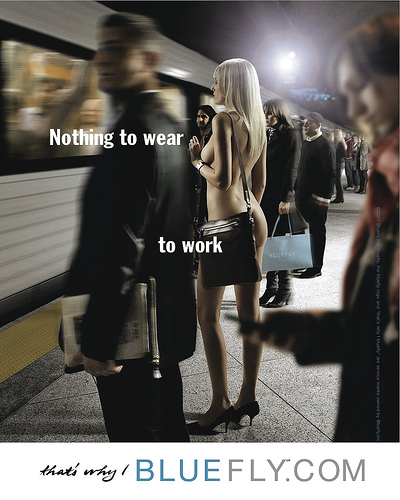
Past the giggles (I mean surprise) of seeing a naked lady, this is a spectacular ad for visualizing the human truth of feeling exposed - uncomfortable as if naked - vulnerable throughout my day in clothes I don't like.

The mastery comes from empathizing with this plight, but instantly providing right solutions that meet her needs. Intimacy - understanding the minutiae of everyday life.

"This campaign is not about nudity - it's about feeling naked, which is very different. These days more than ever, what you wear is inextricably linked to who you are. Without the 'right' clothes we experience an identity crisis. So our tagline 'That's Why I Bluefly' is the perfect antidote for this condition." Bluefly President and CEO Melissa Payner tells Adrants.

Mitch's School of Story Telling

I came across a wiki of Mitch Hedberg quotes, and was delighted. Not only do I think he is hilarious, but is an excellent storyteller who makes a good point:
  • I'd like to see a forklift lift a crate of forks. It'd be so damn
    literal. "Hey, you're using that machine to its exact purpose!"
  • I don't have a girlfriend. I just know a girl who would get really mad if she heard me say that.
  • I have no problem not listening to The Temptations, which is weird.
  • I rent a lot of cars, but I don't always know everything about
    them. So a lot of times, I drive for like ten miles with the emergency
    brake on. That doesn't say a lot for me, but it really doesn't say a
    lot for the emergency brake. It's really not an emergency brake, it's an emergency "make the car smell funny" lever.
  • I'm not good at golf, I never got good. I never got a hole in one,
    but I did hit a guy. And that's way more satisfying. You're supposed to
    yell "Fore", but I was too busy mumbling "There ain't no way that's
    gonna hit him."
  • I went camping once, and got into an argument with a girl friend in
    the tent. This is a really bad place to get in an argument, because I
    walked out and attempted to "slam the flap." How are you supposed to
    express your anger in this type of situation? Zipper it up really quick?
Trying some mitch'isms of my own:

  • The phrase, "funny cause it's true," is true, and that's funny.
  • "Obvious" just means you haven't taken the time to think about it further, which makes you mad when someone else did and finds something new, then makes you look dumb when you say, "that's my idea!" (but your boss can do that, which makes you mad for other reasons)

With a few other thoughts:

  • A successful story needs to fit the framework for what your audience understands, but challenges what they expect.
  • Good stories develop all the right details, but unfolds at the right time.
  • Never disagree with a double negative, unless it's wrong.
  • "God made beef perfect, we just have to not ruin it," said Tubby (the Food Network judge).


Never the Same

Charles Halton wrote a great article found at ChangeThis, where he outlines 18 characteristics that are essential for creating transformational experiences. Listed below are many, if not all his points with some added notes. I recommend downloading the PDF to print off and keep forever.

[I'll add points in the morning when not so sleepy...]

archived by date